
Casino
![[photo: Beach Museum of Art, Kansas State University, Manhattan, KS]](https://lh3.googleusercontent.com/blogger_img_proxy/AEn0k_umQID8F3g_vbVcyLGsfTAtkariWw7AZb0sWgYsmHhG7zVrHsNOGg_jdt-zT-XiI0Le6h-AqduoP3jyU2QC8MShBYcfDeeSQHIa=s0-d)
Museum
or
![[photo: Kansas Museum of History, Topeka, KS]](https://lh3.googleusercontent.com/blogger_img_proxy/AEn0k_tbJSY4ycS3hfmRDggLELnqTKx9vP8LhCXt7HqI1wWtgGjIEgTcy-pmDlPYkdrD_JZx40Wav_rtOUkdZQ1XpSzfsEo8HEKVK6uDjO9lCg=s0-d)
Museum

Casino
See the difference, Senator Sam and Senator Pat ? Different. Really.
Best, for museums, George
These materials were prepared for the Markkula Center for Applied Ethics program in Government Ethics by Senior Fellow Judy Nadler and Communications Director Miriam Schulman. The Center provides training in local government ethics for public officials.
What are conflicts of interest?
Conflicts of interest occur when an officeholder puts his or her personal or financial interest ahead of the public interest. In the simplest terms, the official reaps a monetary or other reward from a decision made in his or her public capacity.
The most common conflicts in local government happen when officeholders face a vote on real property/land use issues that affect their own holdings. Other examples include voting to grant a benefit to a company in which the officeholder owns stock or even to a non-profit organization on whose board the officeholder may sit.
When a conflict of interest is possible, an officeholder is expected to abstain from the discussion and the vote.
What do conflicts of interest have to do with ethics?
Public service is always about protecting the common good, which may be defined as the common conditions that are important to the welfare of everyone-police, fire, parks, libraries, and other services. A public servant must always put the common good ahead of any personal, financial, or political benefit they might receive from a decision about such matters as where to situate a park or who should collect the garbage.
Also, conflicts of interest interfere with the basic ethical principle of fairness-treating everyone the same. A public official should not take unfair advantage of his or her position by voting on a matter that could benefit them at the expense of others.
Finally, conflicts of interest undermine trust. They make the public lose faith in the integrity of governmental decision-making processes.
What ethical dilemmas do conflicts of interest present?
Many times, government officials honestly believe that they are not being unduly influenced by their personal stake in an issue. They may feel, to the contrary, that their interest in the matter gives them special insight into the subject. A city councilmember who ran on a platform of revitalizing the downtown, for example, may feel entirely justified in supporting measures to improve the area, even if part of the benefit of such improvement might go to their own business. They might argue that they understand the problems of a downtown business because they own one. They might claim, further, that their constituents elected them specifically to represent this interest.
But conflict of interest laws prevent such partiality. First, it's almost impossible for individuals to determine whether they are being fair when their self-interest is involved. Also, as the Institute for Local Self-Government puts it, "The law is aimed at the perception, as well as the reality, that a public officials personal interests may influence a decision." Even the appearance of impropriety undermines the public's faith that the process is fair.
Another common misconception about conflicts of interest is that officeholders are absolved of their responsibility merely by being transparent about their stake in the issue. It is not sufficient for government officials to make conflicts public. They must take themselves out of the decision-making process altogether.
This includes discussion and debate as well as actual voting. Abstention is only half the requirement. A public official is also expected to refrain from public pronouncements and private arm twisting on decisions in which he or she has an interest.
Note, also, that the interest may be personal as well as financial. Helping one's fraternal order to obtain rent-free space in a public building is a form of conflict of interest, especially if it improves one's standing in the organization. Being elected president of a community group because of such favors might prove to be in an officeholder's personal and political interest when the next election rolls around. Conversely, public office should not be used to punish one's personal and political enemies. Voting no on your annoying neighbor's reasonable zoning waiver request is another form of putting private ahead of public interest.
(e) Conflict of Interest - No elected or appointive city official or employee, whether paid or unpaid, shall engage in any business or transaction or shall have a financial or other personal interest, direct or indirect, which is incompatible with the proper discharge of his or her duties in the public interest or would tend to impair his or her independence of judgment or action in the performance of his or her official duties. Personal as distinguished from financial interest includes an interest arising from blood or marriage relationships or close business or political association. Specific conflicts of interest are enumerated below for the guidance of officials and employees:
...There exists no definition within the city code of the term, "city official". However, the fact that this provision contemplates the city official potentially being "appointive" and "unpaid" would lead one to believe that members of city boards are, in fact, included within these provisions....
...it would seem reasonable to contemplate that members of city boards and committees would, in fact, be subject to the conflict of interest provisions found within Article 4 of the city code. However, as I have previously indicated, the code provisions are sometimes vaguely worded and may not be as clear as one would wish.
Dodge City Municipal Code
(e) Conflict of Interest - No elected or appointive city official or employee, whether paid or unpaid, shall engage in any business or transaction or shall have a financial or other personal interest, direct or indirect, which is incompatible with the proper discharge of his or her duties in the public interest or would tend to impair his or her independence of judgment or action in the performance of his or her official duties. Personal as distinguished from financial interest includes an interest arising from blood or marriage relationships or close business or political association. Specific conflicts of interest are enumerated below
for the guidance of officials and employees:
(1) Incompatible Employment - No elected or appointive city official or employee shall engage in or accept private employment or render services for private interests when such employment or service is incompatible with the proper discharge of his or her official duties or would tend to impair his or her independence of judgment or action in the performance of his or her official duties.
(2) Disclosure of Confidential Information -
No elected or appointive city official or employee, shall, without proper legal authorization, disclose confidential information concerning the property, government or affairs of the city. Nor shall he or she use such information to advance the financial or other private interest of himself, herself or others.
Butler gets the contract on a 5-2 vote. Board Chairman Matt All and Jim Bergfalk supported the D.C. Resort proposal. The other members favored Butler.
Next up, a background check.
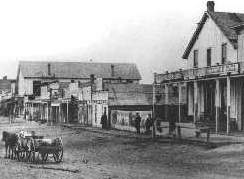
...If Dodge City Resort and Gaming's proposal is selected by the Lottery Gaming Facility Review Board for further development, the casino would be built on 281 acres in the northeast corner of the city by Highway 50. The Western-style casino would consist of 800 gaming machines, 20 gaming tables, conventions and meeting rooms, three rodeo arenas, an RV park and livestock showroom and several buildings reminiscent of Front Street in the 1880s....
...During the first year of operation, the casino developer would pay the state about $13 million in gaming revenues as well as property, local and sales taxes, said Joseph. Of that amount, $1.3 million would be split evenly between the Ford County and Dodge City....

