Our Western Heritage

Our Western Heritage
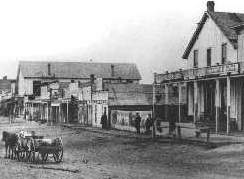
Front Street, Dodge City, circa 1879

Friday, March 27, 2009

Dodge City/Ford County Tourism Plan: Major museum section

That we have a multi-hundred thousand dollar visitor center now is one point -- but that a new Kansas Heritage Center/Ford County History Museum is needed is stated about eight places in the study -- but the submitted suggestion for an actual Ford County History Museums seems missing from the study -- although proposed to Heberling Associates Inc. by several groups involved:

New Dodge City Visitor Center with exhibits

Explore the feasibility of the creation of a Dodge City-Ford County Visitor Center in the downtown cultural corridor. The center, which could share a facility with the expanded Kansas Heritage Center and/or a proposed Ford County Museum, would orient tourists to Dodge City, Ford County, and Southwest Kansas sites and experiences through front-line visitor services as well as interactive orientation kiosks and exhibits describing the region’s history and its cultural, arts, recreational, and environmental sites and attractions.


Use of empty buildings in Dodge City for exhibits


Initiate an assessment, including a market survey, of the Robinson’s complex, or a portion thereof (perhaps removing the 20th century one-story additions), for possible adaptive reuse as a heritage and arts center in the downtown cultural corridor. Uses could include artists’ studio rental space, studio space for workshops and classes (possibly including homes for various kinds of artists’ guilds), opportunities for showcasing large exhibits or exhibits of large pieces, meeting rooms, and a Ford County History Center with a collections storage area.


Use of Ford County Government Center for exhibits

The Roundup could also develop an interpretive exhibit—or series of exhibits—on its own interesting history, either in conjunction with the hall of fame or in another location, such as the lobby of the County Government Center, a Dodge City/Ford County Visitors Center, the Boot Hill Casino and Resort (or all of the above).


New Kansas Heritage Center for exhibits

USD 443 representatives should authorize a feasibility study for the development of an expanded Kansas Heritage Center and determine the best location for such a facility.

Possible sites include the former T.M. Deal Lumber Company at Third and Spruce, the old City Hall and parking lot property on top of Boot Hill between Third and Fifth Avenues on Spruce, the former Robinson’s furniture store, casino land west of town, and the Roundup Rodeo-Fairgrounds neighborhood south of downtown. There has been general agreement thus far that one of the downtown locations would be the most appropriate. Butler National has already generously donated the services of a talented architect who has prepared a very preliminary design concept and floor plan for a new KHC.

The study should also determine whether a new KHC should share a complex or be linked architecturally to a related or complementary organization’s facility, such as a Dodge City-Ford County visitors center, a Ford County Historical Society, the Genealogical Society Library, and/or a joint archival research center made up of the two-dimensional collections perhaps from the KHC, Boot Hill Museum, and County Historical Society.

The Kansas Heritage Center could provide expanded facilities for its existing educational and research service operations as well as gallery space for traveling and temporary exhibits from large to small and on all topics relevant to the history, cultural heritage, environment, and lifeways of the High Plains. It could also include spaces for public meetings and events. The KHC should avoid the temptation to become a museum that collects three-dimensional artifacts.


No actual museum in the study:

But, alas, the submitted and discussed material on an actual modern secure history museum is just not in the Dodge City Tourism Master Plan at all? Could it have been lost by Heberling Associates? Edited out?


Dodge City/Ford County, KS, Master Tourism Plan On-line

Dodge City/Ford County Master Tourism Plan: how to measure success

Here's the check list that Heberling Associates Inc. say should be used to measure the success of the new Dodge City/Ford County Master Tourism Plan, the new arts & tourism director position and the community putting it all into action.


􀁸 Annual increase in visitation and attendance at events.
􀁸 Broader visitor demographics.
􀁸 Expanded volunteer base.
􀁸 New events and programs.
􀁸 Expanded community participation and support.
􀁸 Expanded casino attendance.
􀁸 Increased corporate, agency, and attraction partnerships and collaborations.
􀁸 Implementation and expansion of cross-marketing between Boot Hill Casino and
Resort and downtown retail and attractions.
􀁸 Expanded donor base.
􀁸 Increased public and private funding.
􀁸 Increased sales and bed tax revenue.
􀁸 Positive and increased gaming revenue.
􀁸 Increased in-kind support for projects and attractions.
􀁸 Increased number of capital projects and infrastructure improvements.
􀁸 New and expanded downtown tourism-related businesses and services.
􀁸 Increased number of tourism-related jobs.
􀁸 More positive visitor feedback.
􀁸 Improvements in visitor/hospitality services.
􀁸 Increased downtown activity.
􀁸 Increase in number of restored and rehabilitated historic buildings.
􀁸 Expanded media coverage.
􀁸 Expanded web presence and feedback.
􀁸 Increased number of positive online comments.
􀁸 Expanded use of appropriate and relevant digital technology and user feedback.


Dodge City/Ford County, KS, Master Tourism Plan On-line

Dodge City/Ford County Master Tourism Plan: $103,000 Answers

Here's the meat of the Heritage Tourism Plan for Dodge City and Ford County, Kansas -- not Heberling Associates, Inc. fault that it reads almost the same as the study done in early 1990s and in about 2004 -- paid for again -- these are obvious points:

􀁸 To recognize tourism in general as a powerful economic development tool for the community and the region.
􀁸 To enhance visitor satisfaction.
􀁸 To integrate tourism into the social and economic life of the region.
􀁸 To enhance history and the arts as opportunities for heritage tourism and economic development.
􀁸 To promote a sustainable High Plains environment as a significant component of a visitor marketing and promotional plan.
􀁸 To effectively promote and market the region’s unique visitor assets.
􀁸 To create lively and educational experiences for visitors of all ages and backgrounds.
􀁸 To enhance the tourism infrastructure.
􀁸 To implement needed wayfinding and informational strategies and an integrated
system of logistical links and connections among visitor venues.
􀁸 To be accessible to a diverse local, national, and global market.
􀁸 To create experiences and the opportunities for discovery about the region and its natural, historic, and cultural setting.


And they add:

A reasonable degree of public funding for attractions in the current economic environment and beyond is a wise investment in regional economic development and an expanded visitor industry.


Dodge City/Ford County, KS, Master Tourism Plan On-line

Tuesday, February 10, 2009

For Senator Roberts, Senator Brownback: pictorial help, museums versus casinos


Casino


[photo: Beach Museum of Art, Kansas State University, Manhattan, KS]

Museum


or

[photo: Kansas Museum of History, Topeka, KS]

Museum


Casino


See the difference, Senator Sam and Senator Pat ? Different. Really.

Best, for museums, George

Friday, December 12, 2008

Dodge City Commission: Conflict of Interest Guidance

Here's an excerpt from the Government Ethics: Markkula Center for Applied Ethics site, one great resource on ethics. Perhaps a discussion might start? Perhaps the City of Dodge City Commissioners might want to improve our local conflict of interest laws before spending millions and millions of dollars? Yours, Uncle George

Conflicts of Interest in Government

These materials were prepared for the Markkula Center for Applied Ethics program in Government Ethics by Senior Fellow Judy Nadler and Communications Director Miriam Schulman. The Center provides training in local government ethics for public officials.


What are conflicts of interest?

Conflicts of interest occur when an officeholder puts his or her personal or financial interest ahead of the public interest. In the simplest terms, the official reaps a monetary or other reward from a decision made in his or her public capacity.

The most common conflicts in local government happen when officeholders face a vote on real property/land use issues that affect their own holdings. Other examples include voting to grant a benefit to a company in which the officeholder owns stock or even to a non-profit organization on whose board the officeholder may sit.

When a conflict of interest is possible, an officeholder is expected to abstain from the discussion and the vote.

What do conflicts of interest have to do with ethics?

Public service is always about protecting the common good, which may be defined as the common conditions that are important to the welfare of everyone-police, fire, parks, libraries, and other services. A public servant must always put the common good ahead of any personal, financial, or political benefit they might receive from a decision about such matters as where to situate a park or who should collect the garbage.

Also, conflicts of interest interfere with the basic ethical principle of fairness-treating everyone the same. A public official should not take unfair advantage of his or her position by voting on a matter that could benefit them at the expense of others.

Finally, conflicts of interest undermine trust. They make the public lose faith in the integrity of governmental decision-making processes.

What ethical dilemmas do conflicts of interest present?

Many times, government officials honestly believe that they are not being unduly influenced by their personal stake in an issue. They may feel, to the contrary, that their interest in the matter gives them special insight into the subject. A city councilmember who ran on a platform of revitalizing the downtown, for example, may feel entirely justified in supporting measures to improve the area, even if part of the benefit of such improvement might go to their own business. They might argue that they understand the problems of a downtown business because they own one. They might claim, further, that their constituents elected them specifically to represent this interest.

But conflict of interest laws prevent such partiality. First, it's almost impossible for individuals to determine whether they are being fair when their self-interest is involved. Also, as the Institute for Local Self-Government puts it, "The law is aimed at the perception, as well as the reality, that a public officials personal interests may influence a decision." Even the appearance of impropriety undermines the public's faith that the process is fair.

Another common misconception about conflicts of interest is that officeholders are absolved of their responsibility merely by being transparent about their stake in the issue. It is not sufficient for government officials to make conflicts public. They must take themselves out of the decision-making process altogether.

This includes discussion and debate as well as actual voting. Abstention is only half the requirement. A public official is also expected to refrain from public pronouncements and private arm twisting on decisions in which he or she has an interest.

Note, also, that the interest may be personal as well as financial. Helping one's fraternal order to obtain rent-free space in a public building is a form of conflict of interest, especially if it improves one's standing in the organization. Being elected president of a community group because of such favors might prove to be in an officeholder's personal and political interest when the next election rolls around. Conversely, public office should not be used to punish one's personal and political enemies. Voting no on your annoying neighbor's reasonable zoning waiver request is another form of putting private ahead of public interest.

Monday, November 24, 2008

Serious problem, Dodge City Conflict of Interest ordinances

Finally, thanks to Ken Strobel, City of Dodge City Manager and Brad Ralph, City of Dodge City Attorney, the serious issue of non-applicable conflict of interest ordinances on the Dodge City code has a possible answer -- if the Dodge City Commission decides to fix it -- and fixes it before millions and millions of tax dollars are spent on the Events Center and the infrastructure connected with it and the Casino.

According to a reply on my request for a ruling on whether the City of Dodge City conflict of interest ordinances -- see previous post -- apply to ANY city appointed volunteer committees:


City of Dodge City Code, Article 4, Chapter 1, Article 1-404(e):
(e) Conflict of Interest - No elected or appointive city official or employee, whether paid or unpaid, shall engage in any business or transaction or shall have a financial or other personal interest, direct or indirect, which is incompatible with the proper discharge of his or her duties in the public interest or would tend to impair his or her independence of judgment or action in the performance of his or her official duties. Personal as distinguished from financial interest includes an interest arising from blood or marriage relationships or close business or political association. Specific conflicts of interest are enumerated below for the guidance of officials and employees:


Mr. Ralph states:

...There exists no definition within the city code of the term, "city official". However, the fact that this provision contemplates the city official potentially being "appointive" and "unpaid" would lead one to believe that members of city boards are, in fact, included within these provisions....

...it would seem reasonable to contemplate that members of city boards and committees would, in fact, be subject to the conflict of interest provisions found within Article 4 of the city code. However, as I have previously indicated, the code provisions are sometimes vaguely worded and may not be as clear as one would wish.


Now, time to see if Mr. Strobel and Mr. Ralph suggest a definition of "appointed city officials" and if the Dodge City Commissioners decide that ethics and codes that are applicable to city committee members -- all committees -- are wanted by them or not. If the city commissioners do nothing -- ie.,they now know that there are no conflict of interest codes which clearly apply to appointed committees, including CFAB -- then I guess that conflict of interest issues are not important to them -- I would hate to think that they may want there to be no applicable laws.

I don't want to be that negative -- so I look forward to a very fast update of the codes so that they clearly apply. If this issue matters to you, contact the City Commissioners and ask when they may fix this very glaring problem with Dodge City laws.

They can be reached at:


Monte Broeckelman
Email: mbroeckelman@yahoo.com

Jim Sherer
Email: jim.sherer@yahoo.com

E. Kent Smoll, Mayor
Email: ksmoll70@hotmail.com

Rick Sowers, Vice-Mayor
Email: rsowers@starrtech.net

Brian Weber
Email: commissionerweber@gmail.com


Yours, Uncle George

Friday, October 17, 2008

Dodge City, a town with no interest ?

Currently, a request for a legal ruling on which city committee members of Dodge City are covered by the conflict of interest ordinances is slowly moving through the city attorney's office (or actually, a hired city legal advisor office) -- so it might be useful to first review the current laws -- laws that right now seem to apply to no one at all. Here's the Dodge City laws that should apply -- but, we've been told -- don't since "appointive city official or employee, whether paid or unpaid" was not a term that was defined (and I'm still waiting for a list of city employees that are not paid -- )

Dodge City Municipal Code

(e) Conflict of Interest - No elected or appointive city official or employee, whether paid or unpaid, shall engage in any business or transaction or shall have a financial or other personal interest, direct or indirect, which is incompatible with the proper discharge of his or her duties in the public interest or would tend to impair his or her independence of judgment or action in the performance of his or her official duties. Personal as distinguished from financial interest includes an interest arising from blood or marriage relationships or close business or political association. Specific conflicts of interest are enumerated below
for the guidance of officials and employees:

(1) Incompatible Employment - No elected or appointive city official or employee shall engage in or accept private employment or render services for private interests when such employment or service is incompatible with the proper discharge of his or her official duties or would tend to impair his or her independence of judgment or action in the performance of his or her official duties.

(2) Disclosure of Confidential Information -
No elected or appointive city official or employee, shall, without proper legal authorization, disclose confidential information concerning the property, government or affairs of the city. Nor shall he or she use such information to advance the financial or other private interest of himself, herself or others.


So, the question being asked the City Attorney now is if these laws apply to ANY city committee members at all. Since a couple of the Dodge City commissioners talked much about their ethics during the election, seems to me that if no Dodge City conflict of interest laws apply to anyone, there's not much to talk about concerning ethics in Dodge.

You'll be informed as soon as that nice outside paid lawyer lets us know. Until then, guess that Dodge City has no interests to have conflicts over? Or just no laws concerning what, in most places, would be illegal involvement of appointed city officials making money off of your tax dollars -- and getting to make decisions for their own personal financial gain on how to spend those dollars.

Waiting too, Uncle George